


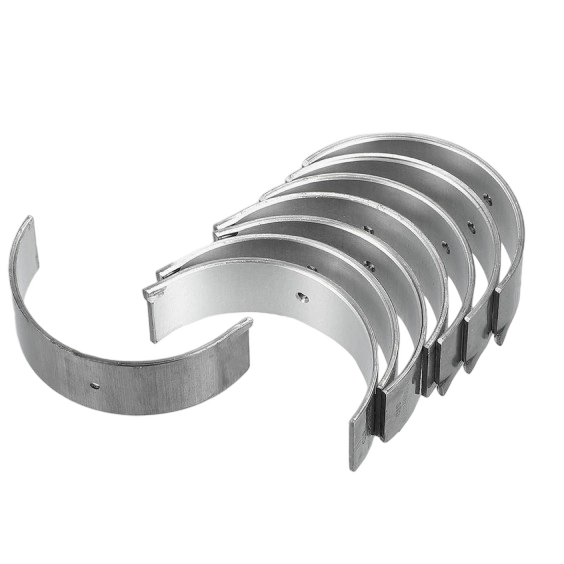
Engine bearings, also known as shell bearings or plain bearings, are among the most critical precision components inside an engine. Unlike ball bearings, they do not have rolling elements. Instead, they are two-piece, semi-circular shells that provide a perfectly smooth, low-friction surface for the engine's rotating parts, primarily the crankshaft and connecting rods. Their function is entirely dependent on a microscopic film of pressurized oil (hydrodynamic lubrication) that separates the bearing surface from the rotating journal, preventing metal-on-metal contact and allowing the engine to turn freely at thousands of RPM.
Functions of Engine Bearings
Reduce Friction
Their primary purpose is to allow the crankshaft to rotate with minimal friction within the stationary engine block and connecting rods.
Support High Loads
They bear the immense forces of combustion and the weight of the rotating assembly, maintaining precise alignment and clearances.
Provide a Sacrificial Surface
Made of softer metals, bearings are designed to wear out before the much harder (and more expensive) crankshaft, protecting it from damage.
Direct Oil Flow
Grooves and holes in the bearings are critical oil passages that channel lubricant to other parts, such as up the connecting rods to the piston pins.
Symptoms of Failing Engine Bearings
Bearing failure is a terminal engine event. The symptoms are severe, and continuing to run the engine will quickly lead to complete seizure and non-repairable damage to the block and crankshaft.
"Rod Knock" or Deep Rumbling
A loud, deep knocking sound (rod bearings) or a heavy rumble (main bearings) from the bottom of the engine that increases with RPM is the classic sign of failure.
Low Oil Pressure
As bearings wear, the clearance increases, allowing oil to escape too easily. This causes a significant and dangerous drop in overall oil pressure.
Metal Flakes ("Glitter") in Oil
A sparkly, glitter-like appearance in the used engine oil is definitive proof of bearing material shedding into the lubrication system.
Engine Seizure
The final stage of failure. Lack of lubrication causes the bearing to weld itself to the crankshaft, completely locking the engine.
Engine Bearing vs. Wheel Bearing
What is a Wheel Bearing?
A wheel bearing is a rolling-element bearing (using balls or rollers) that allows the wheel to spin with minimal friction. It is typically a sealed unit packed with grease, designed to support the vehicle's weight and withstand cornering forces. It operates in a completely different environment and on a different principle than an engine bearing.
| Attribute | Engine Bearing | Wheel Bearing |
|---|---|---|
| Type | Plain / Shell Bearing | Rolling-Element (Ball/Roller) |
| Lubrication | Pressurized Engine Oil Film | Packed Grease |
| Failure Symptom | Knocking / Low Oil Pressure | Humming / Grinding / Wobble |
| Service | Requires full engine disassembly | Replaced at the wheel hub |
An Engine Bearing is like a hydroplaning surfboard, riding on a film of oil; a Wheel Bearing is like a set of roller skates.