


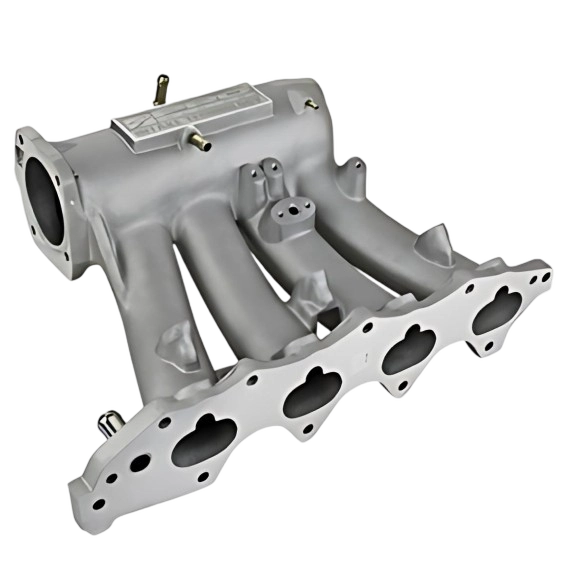
The inlet manifold, more commonly known as the intake manifold, is a series of tubes that distributes the air coming from the throttle body to the individual intake ports on the engine's cylinder head(s). Its design is critical for engine performance, as it must deliver an equal amount of air to each cylinder to ensure balanced operation. In port-injected engines, it also serves as the location where fuel is mixed with the incoming air just before entering the cylinder. Modern manifolds, often made of lightweight composites or aluminum, are highly engineered to optimize air velocity and volume for a specific powerband.
Functions of an Inlet Manifold
Distribute Air Evenly
Its primary function is to divide the single stream of air from the throttle body and deliver an equal charge to each cylinder.
Optimize Air Velocity
The length and diameter of the manifold runners are tuned to create pressure waves that help "push" more air into the cylinders at specific RPMs.
Provide Component Mounting
It houses the fuel injectors and fuel rail (in PFI engines), the MAP sensor, and various vacuum lines for other systems.
Seal the Intake System
With its gaskets, it creates a perfectly sealed path for air, preventing unmetered "vacuum leaks" that disrupt the air-fuel ratio.
Symptoms of a Failing Inlet Manifold
A failing manifold, typically due to a cracked housing or a bad gasket, can cause a variety of hard-to-diagnose engine performance problems and should be addressed promptly.
Check Engine Light (Lean Codes)
A vacuum leak from a bad gasket is the most common failure, allowing unmetered air into the engine and triggering a lean condition code (P0171, P0174).
Rough Idle and Misfires
A vacuum leak disrupts the air-fuel mixture, causing the engine to stumble, run rough, and potentially misfire at idle or low speeds.
Coolant Leak
On many V-type engines, coolant passes through the manifold. A cracked manifold or failed gasket can cause an external or internal coolant leak.
Poor Performance and Acceleration
A significant vacuum leak or a failed runner control valve will cause the engine to feel sluggish and underpowered.
Inlet Manifold vs. Exhaust Manifold
What is an Exhaust Manifold?
The exhaust manifold is the counterpart to the inlet manifold. Bolted to the exhaust ports of the cylinder head, its job is to collect hot, high-pressure exhaust gases from all the cylinders and funnel them into a single pipe that leads to the catalytic converter and the rest of the exhaust system.
| Attribute | Inlet Manifold | Exhaust Manifold |
|---|---|---|
| Function | Distributes Air IN | Collects Gases OUT |
| Pressure | Vacuum (or Boost) | High Positive Pressure |
| Temperature | Relatively Cool | Extremely Hot |
| Material | Plastic/Aluminum | Cast Iron/Stainless Steel |
The Inlet Manifold is the engine's respiratory tract, delivering fresh air; the Exhaust Manifold is the digestive tract, expelling waste.